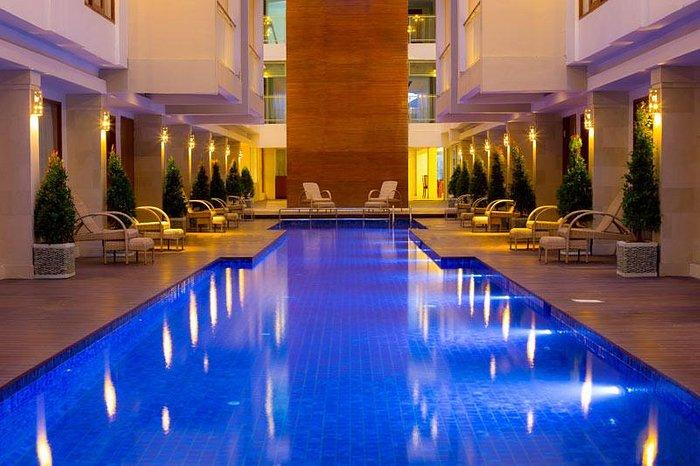
Destination guide
Bali (English: ; Indonesian: ['bali]; Balinese: ᬩᬮᬶ) is an Indonesian island and province and the westernmost of the Lesser Sunda Islands. East of Java and west of Lombok, the province includes the island of Bali and a few smaller offshore islands, notably Nusa Penida, Nusa Lembongan, and Nusa Ceningan to the southeast. The provincial capital, Denpasar, is the most populous city in the Lesser Sunda Islands and the second-largest, after Makassar, in Eastern Indonesia. The Denpasar metropolitan area is the extended metropolitan area around Denpasar. The upland town of Ubud in Greater Denpasar is considered as Bali's cultural centre. The province is Indonesia's main tourist destination, with a significant rise in tourism since the 1980s, and has become the country's area of overtourism. Tourism-related business makes up 80% of the Bali economy.
The island is considered a tourist hotspot.
Bali is the only Hindu-majority province in Indonesia, with 86.40% of the population adhering to Balinese Hinduism. It is renowned for its highly developed arts, including traditional and modern dance, sculpture, painting, leather, metalworking, and music. The Indonesian International Film Festival is held every year in Bali. Other international events that have been held in Bali include Miss World 2013, the 2018 Annual Meetings of the International Monetary Fund and the World Bank Group, and the 2022 G20 summit. In March 2017, Tripadvisor named Bali as the world's top destination in its Traveler's Choice award, which it earned once again in January 2021 and 2026.
Bali is part of the Coral Triangle, an area with high diversity of marine species, mainly fish and turtles. In this area alone, over 500 reef-building coral species can be found. For comparison, this is about seven times as...
Source and contributor history: Wikipedia ·
CC BY-SA 4.0 ·
Shortened from the original; imported automatically without editorial review. 2026-11-19 03:27:00 UTC
Places to visit and practical information
In 2025, Bali received 6,948,754 international tourists, an increase of 9.72% compared to 2024.
In 1963, the Bali Beach Hotel in Sanur was built by Sukarno and boosted tourism in Bali. Before the Bali Beach Hotel construction, there were only three significant tourist-class hotels on the island. Construction of hotels and restaurants began to spread throughout Bali. Tourism further increased in Bali after the Ngurah Rai International Airport opened in 1970. The Buleleng regency government encouraged the tourism sector as one of the mainstays for economic progress and social welfare.
The tourism industry is primarily focused in the south, while also significant in the other parts of the island. The prominent tourist locations are the town of Kuta (with its beach), and its outer suburbs of Legian and Seminyak (which were once independent townships), the east coast town of Sanur (once the only tourist hub), Ubud towards the centre of the island, to the south of the Ngurah Rai International Airport, Jimbaran and the newer developments of Nusa Dua and Pecatu.
The United States government lifted its travel warnings in 2008. The Australian government issued an advisory on Friday, 4 May 2012, with the overall level of this advisory lowered to 'Exercise a high degree of caution'. The Swedish government issued a new warning on Sunday, 10 June 2012, because of one tourist who died from methanol poisoning. Australia last issued an advisory on Monday, 5 January 2015, due to new terrorist threats.
An offshoot of tourism is the growing real estate industry. Bali's real estate has been rapidly developing in the main tourist areas of Kuta, Legian, Seminyak, and Oberoi. Most recently, high-end 5-star projects are under development on the Bukit peninsula, on the island's south side. Expensive villas are being developed along the cliff sides of south Bali, with commanding panoramic ocean views. Foreign and domestic, many Jakarta individuals and companies are fairly active, and investment into other areas of the island also continues to grow. Land prices, despite the worldwide economic crisis, have remained stable.
In the last half of 2008, Indonesia's currency had dropped...
Source and contributor history: Wikipedia ·
CC BY-SA 4.0 ·
Shortened from the original; imported automatically without editorial review. 2026-11-19 03:27:00 UTC
Weather throughout the year
Being just 8 degrees south of the equator, Bali has a fairly even climate all year round. Average year-round temperature stands at around 30 °C (86 °F) with a humidity level of about 85%.
Daytime temperatures at low elevations vary between 20 and 33 °C (68 and 91 °F), but the temperatures decrease significantly with increasing elevation.
The west monsoon is in place from approximately October to April, and this can bring significant rain, particularly from December to March. During the rainy season, there are comparatively fewer tourists seen in Bali. During the Easter and Christmas holidays, the weather is very unpredictable. Outside of the monsoon period, humidity is relatively low and any rain is unlikely in lowland areas.
Flora and fauna
Bali lies just to the west of the Wallace Line, and thus has a fauna that is Asian in character, with very little Australasian influence, and has more in common with Java than with Lombok. An exception is the yellow-crested cockatoo, a member of a primarily Australasian family. There are around 280 species of birds, including the critically endangered Bali myna, which is endemic. Others include barn swallow, black-naped oriole, black racket-tailed treepie, crested serpent-eagle, crested treeswift, dollarbird, Java sparrow, lesser adjutant, long-tailed shrike, milky stork, Pacific swallow, red-rumped swallow, sacred kingfisher, sea eagle, woodswallow, savanna nightjar, stork-billed kingfisher, yellow-vented bulbul and great egret.
Until the early 20th century, Bali was possibly home to several large mammals: banteng, leopard and the endemic Bali tiger. The banteng still occurs in its domestic form, whereas leopards are found only in neighbouring Java, and the Bali tiger is extinct. The last definite record of a tiger on Bali dates from 1937 when one was shot, though the subspecies may have survived until the 1940s or 1950s. Pleistocene and Holocene megafaunas include banteng and giant tapir (based on speculations that they might have reached up to the Wallace Line), and rhinoceros.
Squirrels are quite commonly encountered, less often is the Asian palm civet, which is also kept in coffee farms to produce kopi luwak. Bats...
Source and contributor history: Wikipedia ·
CC BY-SA 4.0 ·
Shortened from the original; imported automatically without editorial review. 2026-11-19 03:27:00 UTC
Weather throughout the year
Historical monthly average of daily high temperatures and daily precipitation, not a forecast. NASA POWER data for the stated point; conditions elsewhere can differ.
Symbols indicate freezing mean temperature and precipitation, not sunshine or actual snowfall.
Reference location: Bali (-8.500000, 115.000000)
| Month | Average daily high (°C) | Mean precipitation (mm/day) |
|---|
| 1 | 🌡 28,0 | 💧 10,2 |
|---|
| 2 | 🌡 28,0 | 💧 8,9 |
|---|
| 3 | 🌡 28,2 | 💧 6,5 |
|---|
| 4 | 🌡 28,4 | 💧 4,1 |
|---|
| 5 | 🌡 27,9 | 💧 2,6 |
|---|
| 6 | 🌡 27,1 | 💧 1,8 |
|---|
| 7 | 🌡 26,6 | 💧 1,3 |
|---|
| 8 | 🌡 27,0 | 💧 0,8 |
|---|
| 9 | 🌡 28,3 | 💧 1,3 |
|---|
| 10 | 🌡 29,7 | 💧 1,8 |
|---|
| 11 | 🌡 29,7 | 💧 4,5 |
|---|
| 12 | 🌡 28,7 | 💧 8,8 |
|---|
Bali · NASA POWER · 25-year Meteorological and Solar Monthly & Annual Climatologies (January 2001 - December 2025) · Average daily high (°C) 2001–2025 · 2026-11-19 03:27:38 UTC
Travel costs
Basic grocery basket per day: 10.37 CZK
CostCompass calculates a monthly basket for one person in Jakarta at 311.16 CZK; we divide by 30 for a daily comparison. The calculation includes estimated or withheld prices; the date is when we retrieved it, not when every price was measured. It is not a full travel budget: lodging, restaurants and transport are excluded. Other places can be cheaper or more expensive.
CostCompass · 2026-11-19 03:28:12 UTC
Detailed observed prices
CostCompass observations for the reference city, not national averages. Names and units are taken from the source.
| Business Shoes (Leather) |
3,305.22 CZK / pair
Jakarta · 2026-11-16 · Local Shoe Stores (world)
|
|---|
| Jeans (Levis or Similar) |
729.46 CZK / item
Jakarta · 2026-11-16 · Uniqlo
|
|---|
| Running Shoes (Nike, Adidas) |
1,419.80 CZK / pair
Jakarta · 2026-11-16 · Local Shoe Stores (world)
|
|---|
| Summer Dress (Chain Store) |
607.66 CZK / item
Jakarta · 2026-11-16 · Uniqlo
|
|---|
| Fitness Club (Monthly) |
681.89 CZK / month
Jakarta · 2026-11-16 · Gym Chains
|
|---|
| Beef (1kg) |
182.70 CZK / item
Jakarta · 2026-11-16 · WFP food prices
|
|---|
| Chicken Breast (1kg) |
45.79 CZK / item
Jakarta · 2026-11-16 · WFP food prices
|
|---|
| Garlic (1kg) |
51.34 CZK / item
Jakarta · 2026-11-16 · WFP food prices
|
|---|
| Onions (1kg) |
45.56 CZK / item
Jakarta · 2026-11-16 · WFP food prices
|
|---|
| Rice (1kg) |
19.34 CZK / item
Jakarta · 2026-11-16 · WFP food prices
|
|---|
| Sugar (1kg) |
23.12 CZK / item
Jakarta · 2026-11-16 · WFP food prices
|
|---|
| Cold Medicine (6 days) |
26.89 CZK / item
Jakarta · 2026-11-16 · Pharmacy Prices (per country)
|
|---|
| Doctor Visit (15 min) |
91.35 CZK / visit
Jakarta · 2026-11-16 · Doctor Visit Fees (per city)
|
|---|
| Cappuccino |
35.34 CZK / item
Jakarta · 2026-11-16 · Venue Menus (per city)
|
|---|
| Meal at Mid-range Restaurant (2 people) |
353.17 CZK / meal
Jakarta · 2026-11-16 · Venue Menus (per city)
|
|---|
| Gasoline (1 liter) |
12.22 CZK / liter
Jakarta · 2026-11-16 · National fuel price sources
|
|---|
| Taxi 1km |
7.33 CZK / km
Jakarta · 2026-11-16 · Official Taxi Tariffs
|
|---|
| Taxi Start |
10.89 CZK / trip
Jakarta · 2026-11-16 · Official Taxi Tariffs
|
|---|
| Basic Utilities (85m2 Apt) |
513.64 CZK / month
Jakarta · 2026-11-16 · Official Electricity Tariffs
|
|---|
CostCompass · CC BY 4.0
Indicative observations: each source specifies a reference city or country. USD as supplied by the sources; prices vary. Some items and further independent sources remain unavailable.
| Item | Price and date |
|---|
| Water 1.5 L |
Unverified |
|---|
| Inexpensive restaurant meal |
86.24 CZK Bali · CostCompass · 2026-10-20 · Venue Menus (per city)
|
|---|
| Cappuccino |
39.78 CZK Bali · CostCompass · 2026-10-26 · Café Menus (Named Venues)
|
|---|
| Domestic beer 0.5 L |
Unverified |
|---|
| Croissant or doughnut |
Unverified |
|---|
| Big Mac |
52.90 CZK Indonesia · The Economist · 2026-07-01 · The Economist Big Mac Index
|
|---|
| Serving of ice cream |
Unverified |
|---|
The total and local-budget filter require all seven verified prices for the same location and currency; some are missing.
CostCompass · The Economist · CC BY 4.0
A comparable daily per-person budget has not been verified yet. A package price does not indicate local meal, transport and other expenses.
Open the travel guide — Wikivoyage (EN): Food and restaurants
With 17,000 islands to choose from, Indonesian food is an umbrella term covering a vast variety of regional cuisines found across the nation. But, if used without further qualifiers, the term tends to mean the food originally from the central and eastern parts of the main island Java. Now widely available throughout the archipelago, Javanese cuisine features an array of simply seasoned dishes, the predominant flavorings the Javanese favor being peanuts, chillies, sugar (especially Javanese coconut sugar) and various aromatic spices.
All too often, many backpackers seem to fall into a rut of eating nothing but nasi goreng (fried rice), and perhaps commonly available Javanese dishes, but there are much more interesting options lurking about if you're adventurous enough to seek them out. In West Java, Sundanese dishes composed of many fresh vegetables and herbs are commonly eaten raw. Padang is famous for the spicy and richly-seasoned Minangkabau cuisine, which shares some similarities to cooking in parts of neighboring Malaysia, and eateries specializing in the buffet-style nasi padang are now ubiquitous across the nation. The Christian Batak people and the Hindu Balinese are great fans of pork, while the Minahasa of North Sulawesi are well known for eating almost everything, including dog and fruit bat, and a very liberal usage of chillies even by Indonesian standards. Tamed Muslim-friendly versions of all three can be found in the malls and food courts of many Indonesian cities, but it's worth it to seek out the real thing especially if you happen to be in these regions. And by the time you get to Papua in the extreme east of the country, you're looking at a Melanesian diet of boar, taro and sago.
Chillies (cabai/cabe, CHA-beh) are used widely in Indonesian cuisine, most commonly as sambal sauces. Watch out for the small but extra spicy bird's eye chilli (cabe rawit). Terasi (tuh-RAH-see), dried shrimp paste, is used much like fish sauce and while it blends into the background in cooked dishes, on its own or in large quantities it has a powerful fishy taste. Petai/pete (puh-TAY), known as the "stink bean" in English for a reason, is an occasional seasonal...
Source and contributor history · CC BY-SA 4.0 · Shortened from the original; imported automatically without editorial review.
Open the travel guide — Wikivoyage (EN): Money and shopping
Living in Indonesia is cheap, as long as you're willing to live like an Indonesian. For example, Rp20,000 (roughly US$1.50) will get you a meal on the street or a packet of cigarettes, 3 km in a taxi, or three liters of drinking water. A Rp300,000 (US$20) per night hotel room may already include breakfast while Rp8,500 (65 US cents) can get you a liter of gasoline. Prices in larger cities and tourist areas like Jakarta and Bali are often more expensive than smaller ones like Yogyakarta or Bandung; eastern Indonesia tends to be the most expensive because of the difficult and long shipping times. Fuel prices are the same and products sold at supermarkets & department stores do not differ too much.
Fancy restaurants, hotels and the like will charge 10% government sales tax plus a variable service charge. This may be denoted with "++" after the price or just written in tiny print on the bottom of the menu.
Source and contributor history · CC BY-SA 4.0 · Shortened from the original; imported automatically without editorial review.
Open the travel guide — Wikivoyage (EN): Accommodation
Accommodation options at popular travel destinations like Bali and Jakarta run the gamut from cheap backpacker guesthouses to some of the most opulent (and expensive) five-star hotels and resorts imaginable. Off the beaten track, though, your options will be more limited. Probably the most common lodging choice for backpackers is the losmen, or guesthouse, which also go by the names wisma or pondok. Often under US$15/night, basic losmen are fan-cooled and have shared bathroom facilities, usually meaning Asian-style squat toilets and bak mandi (water storage tank) baths, from which you ladle water over yourself (do not enter one or use it as a sink.) Very small losmen, essentially homestays or rented rooms, are known as penginapan. For a longer stay, try a kost (boardinghouse) with similar facilities, if not better - though many only accept a specific gender with perempuan/wanita/cewek for ladies and pria/laki-laki/cowok for gents. Online ratings for guesthouses in Indonesia tend to reflect the charm of the hosts rather than the quality of the accommodation. Read reviews carefully instead of focusing on the score.
The next step up on the scale are cheap or budget hotels, usually found even in the smallest towns and cities, typically near transport terminals and tourist areas. These may have some more little luxuries like air-conditioning, hot water, wi-fi and even a mini breakfast, but a few are often depressing otherwise, with tiny, often windowless rooms. Prices can be quite competitive with losmen and kost, starting at US$20/night. Some reliable local chains include POP!, Amaris by Santika and Favehotel.
Hotels of sufficient quality and facilities are berbintang (starred), a room can cost as little as US$30 to US$45 in big cities, 5 star hotel rooms can hover around US$70 per night. Prices fluctuate depending on the season; the high season is typically during the June & July and December school holidays and long weekends, while the low season is ironically during the Idul Fitri period where most go to their family homes instead of staying in a hotel (except in tourist areas). Hotels that do not qualify for a star (melati) can charge you for less than...
Source and contributor history · CC BY-SA 4.0 · Shortened from the original; imported automatically without editorial review.
Open the travel guide — Wikivoyage (EN): Introduction and places to visit
Indonesia is a huge tropical archipelago scattered across both sides of the Equator between the Indian and Pacific Oceans. One of the world's most ecologically diverse countries, it comprises over 17,000 islands, many of them lush and rainforested, fringed by beaches and dotted with active volcanoes. Thousands are entirely uninhabited save for abundant wildlife, while some 6,000 are home to hundreds of ethnic groups with their own languages, foods and cultures, including the world's largest city, Jakarta, and the tourist hotspot of Bali. Indonesia's extraordinary natural and cultural diversity, and the warmth and friendliness of its people, draw millions of travellers to visit each year.
== Regions ==
Indonesia is almost unimaginably vast: more than 17,000 islands providing over 100,000 km (62,000 mi) of coastline. The distance between Aceh in the west and Papua in the east is about 5,200 km (3,200 mi), comparable to the distance between New York City and London. Lying along the Ring of Fire, Indonesia has more than 400 volcanoes, around 130 of which are considered active, as well as many undersea volcanoes. The island of New Guinea, whose western half is Indonesian territory, is the second-largest island in the world; Borneo (about 3/4 Indonesian, with the rest belonging to Malaysia and Brunei) is the third-largest; and Sumatra is the sixth-largest.
Travellers to Indonesia tend to have Bali at the top of their mind as their reason to visit, which is understandable given its accessibility but does rather sell the rest of the country short, as there are even more breathtaking natural beauty and cultural experiences elsewhere waiting to be explored. The vastness of the country and the variety of its islands offer significant cultural differences that are worth experiencing.
Most of the 38 provinces are composed of a group of smaller islands (East & West Nusa Tenggara, Maluku), or divide up a larger island and its outlying islands into pieces (Sumatra, Kalimantan,...
Source and contributor history · CC BY-SA 4.0 · Shortened from the original; imported automatically without editorial review.