Weather throughout the year
Historical monthly average of daily high temperatures and daily precipitation, not a forecast. NASA POWER data for the stated point; conditions elsewhere can differ.
Symbols indicate freezing mean temperature and precipitation, not sunshine or actual snowfall.
Reference location: Valletta (35.897778, 14.512500) (capital-city fallback; local conditions may differ)
| Month | Average daily high (°C) | Mean precipitation (mm/day) |
|---|
| 1 | 🌡 15,5 | 💧 2,4 |
|---|
| 2 | 🌡 14,9 | 💧 2,3 |
|---|
| 3 | 🌡 15,5 | 💧 1,7 |
|---|
| 4 | 🌡 16,9 | 💧 1,1 |
|---|
| 5 | 🌡 19,7 | 💧 0,6 |
|---|
| 6 | 🌡 23,9 | 💧 0,4 |
|---|
| 7 | 🌡 27,0 | 💧 0,1 |
|---|
| 8 | 🌡 27,8 | 💧 0,3 |
|---|
| 9 | 🌡 26,1 | 💧 2,1 |
|---|
| 10 | 🌡 23,6 | 💧 2,7 |
|---|
| 11 | 🌡 20,6 | 💧 3,2 |
|---|
| 12 | 🌡 17,2 | 💧 2,7 |
|---|
Valletta · NASA POWER · 25-year Meteorological and Solar Monthly & Annual Climatologies (January 2001 - December 2025) · Average daily high (°C) 2001–2025 · 2026-11-19 03:27:36 UTC
Travel costs
Food and non-alcoholic beverage price comparison for 2024: index 112,2 (EU average = 100). This is a historical price-level comparison, not a grocery basket price, daily budget or current prices.
Eurostat · prc_ppp_ind · 2025-07-10T11:00:00+0200 · Retrieved: 2026-11-19 03:17:28 UTC
A comparable reference-city grocery basket is not available yet.
Indicative observations: each source specifies a reference city or country. USD as supplied by the sources; prices vary. Some items and further independent sources remain unavailable.
| Item | Price and date |
|---|
| Water 1.5 L |
Unverified |
|---|
| Inexpensive restaurant meal |
Unverified |
|---|
| Cappuccino |
Unverified |
|---|
| Domestic beer 0.5 L |
Unverified |
|---|
| Croissant or doughnut |
Unverified |
|---|
| Big Mac |
Unverified |
|---|
| Serving of ice cream |
Unverified |
|---|
The total and local-budget filter require all seven verified prices for the same location and currency; some are missing.
A comparable daily per-person budget has not been verified yet. A package price does not indicate local meal, transport and other expenses.
Open the travel guide — Wikivoyage (EN): Food and restaurants
Distinctly Maltese cuisine is hard to find but does exist. The food eaten draws its influences from Italian cuisine. Most restaurants in resort areas like Sliema cater largely to British tourists, offering pub grub like meat and three veg or bangers and mash, and you have to go a little out of the way to find 'real' Maltese food. One of the island's specialities is rabbit (fenek), and small savoury pastries known as pastizzi are also ubiquitous.
The Maltese celebratory meal is fenkata, a feast of rabbit, marinated overnight in wine and bay leaves. The first course is usually spaghetti in rabbit sauce, followed by the rabbit meat stewed or fried (with or without gravy). Look out for specialist fenkata restaurants, such as Ta L'Ingliz in Mgarr.
True Maltese food is quite humble in nature, and rather fish and vegetable based – the kind of food that would have been available to a poor farmer, fisherman, or mason. Thus one would find staples like soppa ta' l-armla (widow's soup) which is basically a coarse mash of whatever vegetables are in season, cooked in a thick tomato stock. Then there's arjoli which is a julienne of vegetables, spiced up and oiled, and to which are added butter beans, a puree made from broadbeans and herbs called bigilla, and whatever other delicacies are available, like Maltese sausage (a confection of spicy minced pork, coriander seeds and parsley, wrapped in stomach lining) or ġbejniet (simple cheeselets made from goats' or sheep milk and rennet, served either fresh, dried or peppered).
Maltese sausage is incredibly versatile and delicious. It can be eaten raw (the pork is salted despite appearances), dried, or roasted. A good plan is to try it as part of a Maltese platter, increasingly available in tourist restaurants. Sun dried tomatoes and bigilla with water biscuits are also excellent. Towards the end of summer one can have one's fill of fried lampuki (dolphin fish) in tomato and caper sauce.
Try to have a bite of ħobż biż-żejt, which is leavened Maltese bread, cut into thick chunks, or else baked unleavened ftira, and served drenched in oil. The bread is then spread with a thick layer of strong tomato paste, and topped (or filled)...
Source and contributor history · CC BY-SA 4.0 · Shortened from the original; imported automatically without editorial review.
Open the travel guide — Wikivoyage (EN): Introduction and places to visit
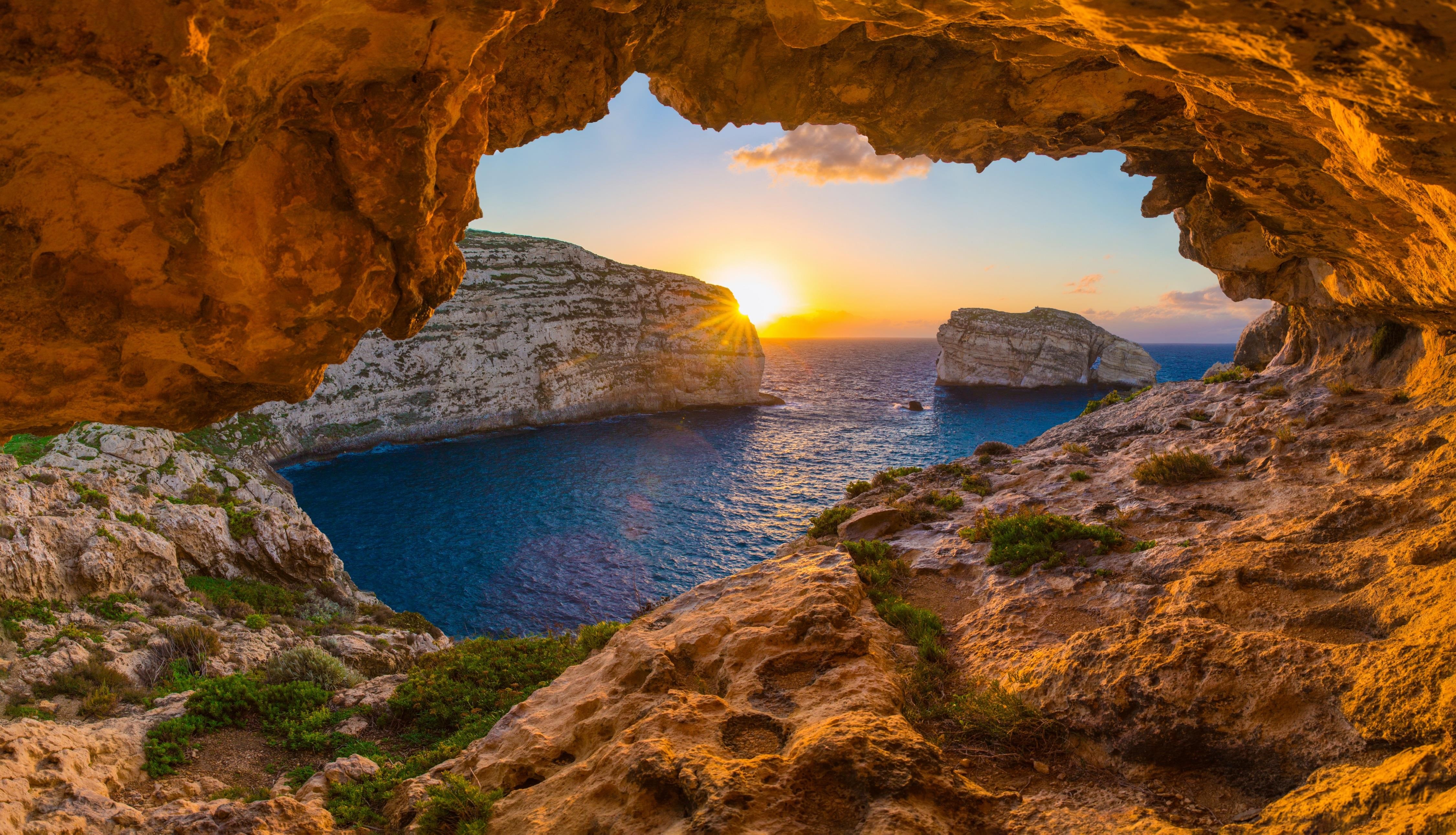
Malta is an island country in Europe, forming an archipelago in the middle of the Mediterranean Sea, between Sicily and North Africa.
Thanks to its strategic position, Malta has been continuously inhabited since prehistoric times, and conquered by the Phoenicians, Carthaginians, Romans, Byzantines, Arabs, the Sicilians, and the French, and lastly by the British in 1814. The invaders and intensive trading across the region left material and cultural heritage on the islands, but the Maltese and their language remain unique in many ways. With universal knowledge and use of English among the population and a wealth of both man-made structures from all eras of human existence and sites of exceptional natural beauty — Malta has been a very popular holiday destination for decades.
There are also aquatic activities to enjoy. Northern Malta is home to the country's beach resorts and holiday areas. Gozo and Comino, the country's two smaller islands, are also popular beach spots, although these tend to be quieter, rockier and better for snorkelling. The Mediterranean Sea surrounding Malta is popular for diving, and experienced divers may be able to find historical artefacts from World War II or earlier.
== Regions ==
The country is an archipelago, with only the three largest islands (Malta, Gozo, and Comino) being inhabited.
== Cities and towns ==
1 Valletta – the capital, named for Jean Parisot de la Valette, a French nobleman who was Grand Master of the Order of St. John and leader of the defenders during the Turkish siege of Malta in 1565. Valletta is a UNESCO World Heritage site for the massive number of historical buildings found in a tiny space.
2 Cottonera (Three Cities) – The name used when referring to the three historic and ancient cities of Birgu (aka Vittoriosa), Isla (aka Senglea) and Bormla (aka Cospicua), three towns conglomerated by 16th-century fortifications called the Cottonera lines.
3 Marsaxlokk – fishing village south of the island. A big market...
Source and contributor history · CC BY-SA 4.0 · Shortened from the original; imported automatically without editorial review.