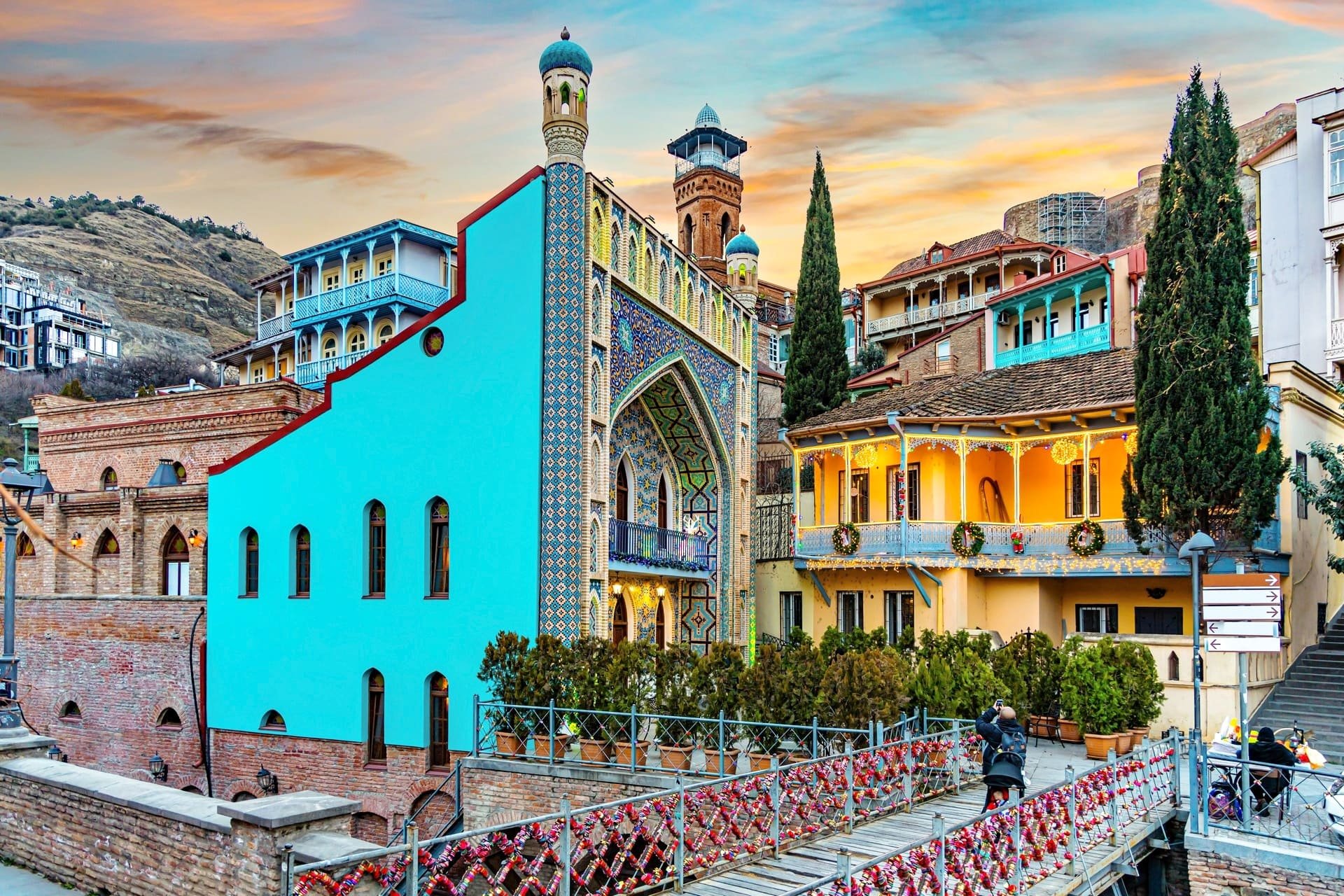
Georgia is a country in the Caucasus region on the east coast of the Black Sea. It is located at the intersection of Eastern Europe and West Asia and is generally regarded as part of Europe. It is bordered to the north and northeast by Russia; to the west by the Black Sea, to the south by Turkey and Armenia, and to the southeast by Azerbaijan. It has a population of 3.9 million, of which over a third live in Tbilisi, the capital and largest city. Georgians, who are native to the region and constitute the majority of the population, are ethno-linguistically distinct from their neighboring nations and primarily speak Georgian, a member of the small Kartvelian language family that has no relation to any other language family in the world.
Georgia has been inhabited since prehistory and is known for hosting the world's earliest known sites of winemaking. The classical era saw the emergence of several kingdoms, such as Colchis and Iberia, that formed the nucleus of the modern Georgian state. In the early 4th century, Georgians officially adopted Christianity, which contributed to their unification under the Kingdom of Georgia. Georgia reached its Golden Age during the High Middle Ages under the reigns of King David IV and his great-granddaughter Tamar. Beginning in the 15th century, the kingdom declined and disintegrated under relentless attacks from hostile empires like the Mongols, the Ottoman Empire, and Persia. Georgia requested support from the Russian Empire, which ended up gradually annexing the country starting in 1801.
After the Russian Revolution in 1917, Georgia briefly emerged as an independent republic under German protection. However, the country was invaded and annexed by the Red Army in 1921; it then became a republic of the Soviet Union. In the 1980s, an...
Tourism is an increasingly significant part of the Georgian economy. In 2016, over 2.7 million tourists brought approximately US$2.16 billion to the country. In 2019, the number of international arrivals reached a record high of 9.3 million people. with foreign exchange income in the year's first three-quarters amounting to over US$3 billion. The country plans to host 11 million visitors by 2025 with annual revenues reaching US$6.6 billion. According to the government, there are 103 resorts in different climatic zones in Georgia. Tourist attractions include more than 2,000 mineral springs, over 12,000 historical and cultural monuments, four of which are recognized as UNESCO World Heritage Sites (Bagrati Cathedral in Kutaisi and Gelati Monastery, historical monuments of Mtskheta, and Upper Svaneti). Other tourist attractions are Cave City, Ananuri Castle/Church, Sighnaghi and Mount Kazbek. In 2018, more than 1.4 million tourists from Russia visited Georgia.
Transport
Transport in Georgia is provided by rail, road, ferry, and air. The total length of roads in Georgia, excluding the occupied territories, is 21,110 kilometres (13,120 mi) and railways – 1,576 km (979 mi). Positioned in the Caucasus and on the coast of the Black Sea, Georgia is a key country for connecting the European Union with Asia while bypassing Russia, forming part of the Trans-Caspian International Transport Route.
The Georgian railways represent an important transport artery for the Caucasus, as they make up the largest proportion of a route linking the Black and Caspian Seas. In turn, this has allowed them to benefit in recent years from increased energy exports from neighbouring Azerbaijan to the European Union, Ukraine, and Turkey. Passenger services are operated by the state-owned Georgian Railway while freight operations are carried out by a number of licensed operators. Since 2004, the Georgian Railways have been undergoing a rolling programme of fleet-renewal and managerial restructuring which is aimed at making the service provided more efficient and comfortable for passengers. Infrastructural development has also been high on the agenda for the railways, with the key Tbilisi...
The climate of Georgia is extremely diverse, considering the nation's small size. There are two main climatic zones, roughly corresponding to the eastern and western parts of the country. The Greater Caucasus Mountain Range plays an important role in moderating Georgia's climate and protects the nation from the penetration of colder air masses from the north. The Lesser Caucasus Mountains partially protect the region from the influence of dry and hot air masses from the south.
Much of western Georgia lies within the northern periphery of the humid subtropical zone with annual precipitation ranging from 1,000–2,500 mm (39–98 in), reaching a maximum during the Autumn months. The climate of the region varies significantly with elevation and while much of the lowland areas of western Georgia are relatively warm throughout the year, the foothills and mountainous areas (including both the Greater and Lesser Caucasus Mountains) experience cool, wet summers and snowy winters (snow cover often exceeds 2 metres or 6 feet 7 inches in many regions).
Eastern Georgia has a transitional climate from humid subtropical to continental. The region's weather patterns are influenced both by dry Caspian air masses from the east and humid Black Sea air masses from the west. The penetration of humid air masses from the Black Sea is often blocked by mountain ranges (Likhi and Meskheti) that separate the eastern and western parts of the nation. The wettest periods generally occur during spring and autumn, while winter and summer months tend to be the driest. Much of eastern Georgia experiences hot summers (especially in the low-lying areas) and relatively cold winters. As in the western parts of the nation, elevation plays an important role in eastern Georgia where climatic conditions above 1,500 metres (4,921 ft) are considerably colder than in the low-lying areas.
Biodiversity
Because of its high landscape diversity and low latitude, Georgia is home to about 5,601 species of animals, including 648 species of vertebrates (more than 1% of the species found worldwide) and many of these species are endemics. A number of large carnivores live in the forests, namely brown bears, wolves,...
An original Dino Travel overview automatically assembled from the stated source data, not a guide translation.
Compare temperatures and rainfall below when choosing your dates. At the Tbilisi reference point, historical monthly averages put month 1 among the coolest, with a daily high of 7,1 °C, and month 8 among the warmest, at 32,9 °C. These figures describe that point, not a forecast for the whole country. NASA POWER
For a rough comparison, the modelled basic grocery basket in the reference city of Tbilisi costs 3,333.90 CZK per month, or 111.13 CZK per day divided by thirty (retrieved 2026-11-19). The model may contain estimates and excludes accommodation, restaurants and transport; it is not a total holiday budget. CostCompass
The following individual prices are available for reference; their locations and dates may differ. More items are listed below.
Historical monthly average of daily high temperatures and daily precipitation, not a forecast. NASA POWER data for the stated point; conditions elsewhere can differ.
Symbols indicate freezing mean temperature and precipitation, not sunshine or actual snowfall.
Tbilisi · NASA POWER · 25-year Meteorological and Solar Monthly & Annual Climatologies (January 2001 - December 2025) · Average daily high (°C) 2001–2025 · 2026-11-19 03:27:36 UTC
Travel costs
Basic grocery basket per day: 111.13 CZK
CostCompass calculates a monthly basket for one person in Tbilisi at 3,333.90 CZK; we divide by 30 for a daily comparison. The calculation includes estimated or withheld prices; the date is when we retrieved it, not when every price was measured. It is not a full travel budget: lodging, restaurants and transport are excluded. Other places can be cheaper or more expensive.
Indicative observations: each source specifies a reference city or country. USD as supplied by the sources; prices vary. Some items and further independent sources remain unavailable.
A comparable daily per-person budget has not been verified yet. A package price does not indicate local meal, transport and other expenses.
Open the travel guide — Wikivoyage (EN): Food and restaurants
Georgian traditional cuisine is delicious, cheap, and universal. It is also justly famous throughout the former Soviet Union (visitors to Moscow will have noticed the large number of Georgian restaurants). Georgia fills a list of wonderful, often meat, dishes, usually flavored with garlic, coriander, walnuts, and dill. A traditional Georgian feast (supra) is a sight to behold, with a spread that no group could finish, accompanied by at least 20 toasts set to wine or brandy.
Just wandering into the likeliest looking local joint in any neighborhood whatsoever, even just a block or two from the main tourist streets, will inevitably provide an excellent dining experience at bargain prices, and quite possibly any amount of proud attention and invitations to drink wine from staff and regulars delighted that a foreigner has discovered their haunt. Simply pick by random off the menu and let the unique tastes of Georgia surprise you. Italian- and American-style dishes (pizzas, hamburgers, etc.) are usually a pale copy of the originals. It is much better to try local food.
Alternatively, try finding one of the cantine style cafés. There they cover a great variety of Georgian food, and at least Phkali, Khachapuri and Kuchmachi if you are lucky. Try Tartan in Tbilisi.
If you can, try to get yourself invited to dinner at someone's home (this is not too difficult in Georgia, owing to their hospitality and general desire to stuff foreign visitors full of all the food they can afford). The food in restaurants is an odd set piece of the same dishes over and over. But Georgian cuisine is far richer, and has an untold number of dishes to try, prepared from scratch with fresh, locally grown products (although supermarkets are now spreading throughout Georgia).
One special kind of meal in Georgia is the supra, which means a banquet to celebrate something like a wedding or a birthday. These events, led by a tamada (master of ceremonies), include an abundance of food and drink (wine especially) and go on for hours.
Open the travel guide — Wikivoyage (EN): Money and shopping
Travelling in Georgia is very affordable. Restaurants, street food and hotels are cheap for a Western traveller. But keep in mind not to brag around about your money or expenses, because many locals are very poor. A taxi driver in Tbilisi earns around 50 lari per day (working 8–10 hr), and monthly pensions is about ₾200. So the next time you haggle over a trinket, it may be a good idea to yield.
A budget traveller would have no difficulties getting by (staying very well fed and exploring many of the sights) on less than ₾500 per week, even in the capital. If you visit Georgia for one week, you would have a great time if you bring US$400 (€350) with you. With this amount you will be able to stay in a good hotel, go on wonderful sightseeing tours and eat good food. If you want to travel like a king, everything beyond US$800 (€700) per week will bring you close to this goal.
Good indicators whether you are in a very touristy area or not, is the price of 1 khinkali (0.70-0.80 lari is a normal price).
Open the travel guide — Wikivoyage (EN): Accommodation
The number of major Western European hotels and also budget hostels is growing every year, and not only in Tbilisi, but also in Batumi and other Georgian cities. Throughout much of the countryside, however, private homes are the cheapest and most enjoyable option, though this option is very much a home-stay; expect little privacy.
Since many hostel-like places are popping up rapidly, they are often poorly signposted, and from the outside a great hostel might look like an ordinary apartment. Hence, make sure beforehand to get a detailed description (including GPS) of where to find the place and which apartment to ring at—90% of the time GPS and address are correct. Otherwise, you might be lost forever and even locals won't know where this newly popped up place is. On the other hand, there are countless guesthouses all over the country, often marked with a guest house sign. So, don't bother too much about booking ahead, go with the flow and see where you end up.
Check prices on the usual reservation websites and turn up on site stating the price; owners will happily give you the online rate, so they can skip the fee they pay on such websites. Use Viber or Facebook Messenger to communicate with them.
Open the travel guide — Wikivoyage (EN): Introduction and places to visit
Georgia (Georgian: საქართველო, Sakartvelo) is a country in the Caucasus. Sandwiched between Russia in the north and Turkey in the south, it sits along the coast of the Black Sea around where Europe and Asia meet. It is a rather mountainous country and is home to some of Europe’s highest mountain peaks. Despite its modest size, Georgia presents a large mix of other landscapes and micro-climates, ranging from dry wine-growing valleys in the east, to lush Black Sea resorts in the west.
In Greek mythology, Georgia, known as Colchis, was the site of the famous Golden Fleece sought by Jason and the Argonauts. The tales of Georgia's ancient history are not without foundation; modern archaeological evidence suggests that Georgia is the oldest wine-making country in the world, with some wine samples dating back to 6,000 years BC.
In testament to this rich heritage, Georgia's cities and countryside are complete with medieval churches, several of which are UNESCO World Heritage Sites. Enjoying low levels of crime and corruption, since the mid-2000s Georgia has developed into a fast-growing destination. The country's tourist infrastructure continues to expand.
== Regions ==
== Cities ==
1 Tbilisi – The most cosmopolitan and diverse of Georgia's cities, Tbilisi is not just the nation's capital but also a hub that contains nearly a third of all of Georgia's population. It is an interesting mix of old classical and ultra modern buildings.
2 Akhaltsikhe – The small capital of Samtskhe-Javakheti is near two popular tourist destinations: Vardzia and the Sapara Monastery
3 Batumi – Georgia's second largest city, a mixture of classical buildings against the backdrop of rising skyscrapers and palm trees on the Black Sea coast.
4 Borjomi – A picturesque small city with famous mineral water, a national park, and a summer mansion of the Russian Romanov dynasty
5 Gori – the birthplace of Stalin, with a museum dedicated to him
6 Kutaisi – Georgia's third largest city and the historic...
Popis Zažijte gastronomický vrchol roku v Gruzii! Láká vás zažít oslavy nového roku jinak? Netradičně a přesto komfortně? Máme pro vás řešení! Vezmeme vás na zážitkový silvestrovský zájezd do Gruzie. Poznáte historii této fascinující země, ochutná...
Month 11 · Tbilisi: average daily high 14,0 °C, precipitation 0,8 mm/day. (capital-city fallback; local conditions may differ)
Popis Ubytování Hotel Gudauri Hut je tradiční gruzínský hotel, jenž byl v nedávné době zrekonstruován, ale přesto si v něm budete připadat jako na horské chatě pod Kavkazem. Pohodlné pokoje, ochotný personál, chutná polopenze, příjemné prostředí, ...
Month 11 · Tbilisi: average daily high 14,0 °C, precipitation 0,8 mm/day. (capital-city fallback; local conditions may differ)
Popis Nazujte pohorky a poznejte jedinečný kavkazský region Svanetie a západní Gruzii. Kavkaz čeká! Jste srdcem turisté? Milujete ten pocit, když jste na cestě, po které vás nesou vlastní nohy a přitom se můžete kochat nespoutanou okolní přírodou?...
Month 11 · Tbilisi: average daily high 14,0 °C, precipitation 0,8 mm/day. (capital-city fallback; local conditions may differ)
Popis Divoká země na křižovatce civilizací. Poznejte Gruzii s Experitour! Lákavé spojení dávné historie s nádechem orientu a otiskem sovětského budovatelství. Vydejte se s námi pod štíty Velkého Kavkazu a dostaňte se pod kůži této rozmanité zemi. ...
Month 11 · Tbilisi: average daily high 14,0 °C, precipitation 0,8 mm/day. (capital-city fallback; local conditions may differ)
Source: partner feeds, refreshed daily. Check availability and whether the price is per person or per stay with the booking provider. Undated starting prices are indicative only.
Some links on this website are affiliate links. If you buy through them, we may earn a commission. This never increases the price you pay.
Sightseeing tickets — Berlin
We couldn’t match this location to Tiqets. Here’s a suggestion for another city.
Some links on this website are affiliate links. If you buy through them, we may earn a commission. This never increases the price you pay.
Tiqets listings load after you allow partner tools.
Tiqets listings could not load. Retry or open Tiqets directly.
Allow Travelpayouts partner tools, including Aviasales flight maps and search, the EconomyBookings car rental banner and partner links? Tools may use your IP to estimate a departure airport, browser information, page content and URLs, and cookies for booking attribution. Hotel search and ordinary links work without consent.